The Implicit Move Footgun: Dangling Pointers in C++
How implicit moves copy raw pointers instead of transferring ownership, creating dangling pointer bugs.
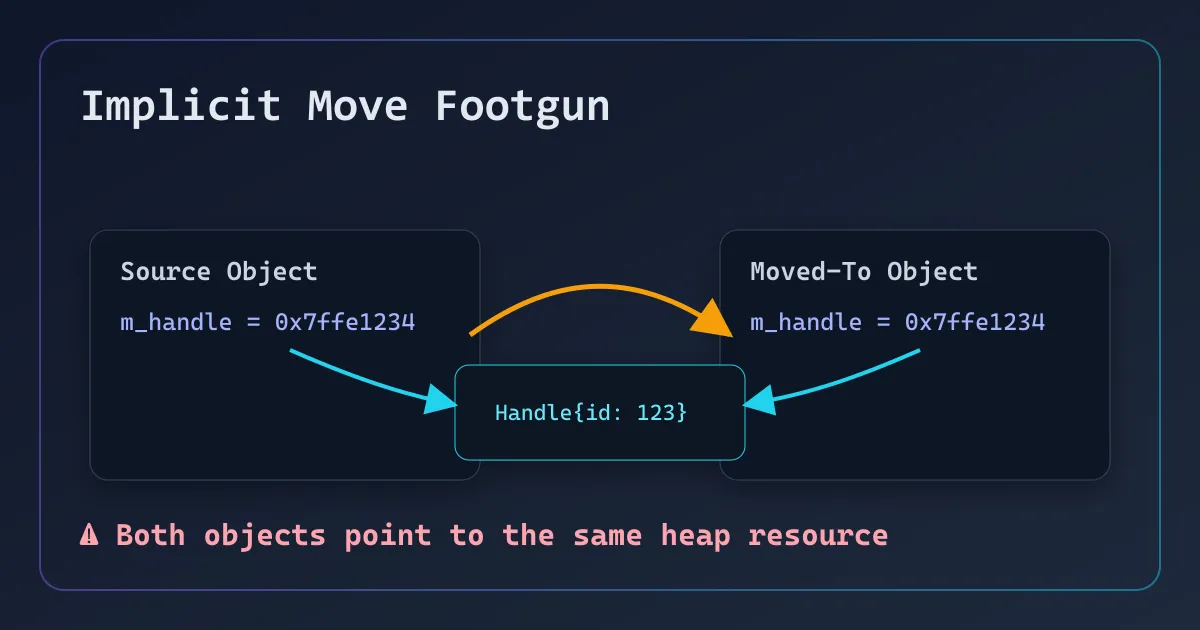
Diagram showing implicit move performing a shallow pointer copy
When you don’t define explicit move semantics, the compiler generates a default move constructor that performs memberwise moves. For types like std::unique_ptr or std::string, this works correctly because they properly transfer ownership.
But raw pointers -and other integral types- are different. When the compiler performs a memberwise move of a raw pointer, it just copies the pointer value. There’s no special ownership transfer semantics, both the source and destination end up owning the same resource.
The Silent Shallow Copy
struct Handle
{
    int id{123};
};

class Connection
{
private:
    Handle* m_handle{nullptr};

public:
    Connection()
    {
        m_handle = new Handle{};
    }
    ~Connection()
    {
        delete m_handle;
    }

    // Compiler generates (implicitly):
    Connection(Connection&& other) noexcept
    : m_handle(other.m_handle)    // ← Copies the pointer value
    {
        // Without explicit move semantics, this default just copies the pointer.
        // Both objects now think they own m_handle.
    }
};
Now two objects think they own the same resource. When the source object is destroyed, it deletes the memory. The destination object now holds a dangling pointer.
auto c1 = Connection{};
auto c2 = Connection{std::move(c1)};  // Shallow copy, not a move
// c1.m_handle and c2.m_handle point to the same Handle

c1.~Connection();  // Calls delete on m_handle
// Now c2.m_handle is a dangling pointer

// Accessing c2.m_handle now is undefined behavior
// c2.~Connection() will delete already-freed memory
The Fix
struct Handle
{
    int id{123};
};

class Connection
{
public:
    Connection()
    {
        m_handle = new Handle{};
    }
    ~Connection()
    {
        delete m_handle;
    }

    // Explicit move: transfer ownership
    Connection(Connection&& other) noexcept
        : m_handle{other.m_handle}
    {
        other.m_handle = nullptr;  // Clear the source—it no longer owns the resource
    }

    Connection& operator=(Connection&& other) noexcept
    {
        if (this != &other)
        {
            delete m_handle;
            m_handle = other.m_handle;
            other.m_handle = nullptr;
        }
        return *this;
    }

    Connection(const Connection&) = delete;
    Connection& operator=(const Connection&) = delete;

private:
    Handle* m_handle{nullptr};
};
By nullifying the source’s pointer after the move, we ensure only one object owns the resource at any time.
Why This Matters
Memberwise copying works fine for integral types (int, float, size_t)—they’re value types. But for pointers, a copy merely duplicates the address, not the ownership semantics. Without explicit moves that clear the source, you get multiple owners pointing to the same resource, leading to double-deletes or use-after-free bugs.
For other types like std::string, std::vector, or std::unique_ptr, default move semantics work correctly because those types have proper move constructors that transfer ownership. But raw pointers have no such semantics—they’re just addresses.
// This would NOT have the problem:
class SafeConnection
{
private:
    std::unique_ptr<Handle> m_handle{};  // Smart pointer with move semantics
};

auto c1 = SafeConnection{};
auto c2 = SafeConnection{std::move(c1)};  // Proper move—c1.m_handle is now nullptr
The issue only exists with raw pointers because they lack built-in ownership transfer semantics.
The Rule
Never rely on implicit move semantics for pointer-owning classes. Always define explicit move operations that transfer ownership by clearing the source. Alternatively, use move-only smart pointers (unique_ptr) to enforce correctness at compile time.